
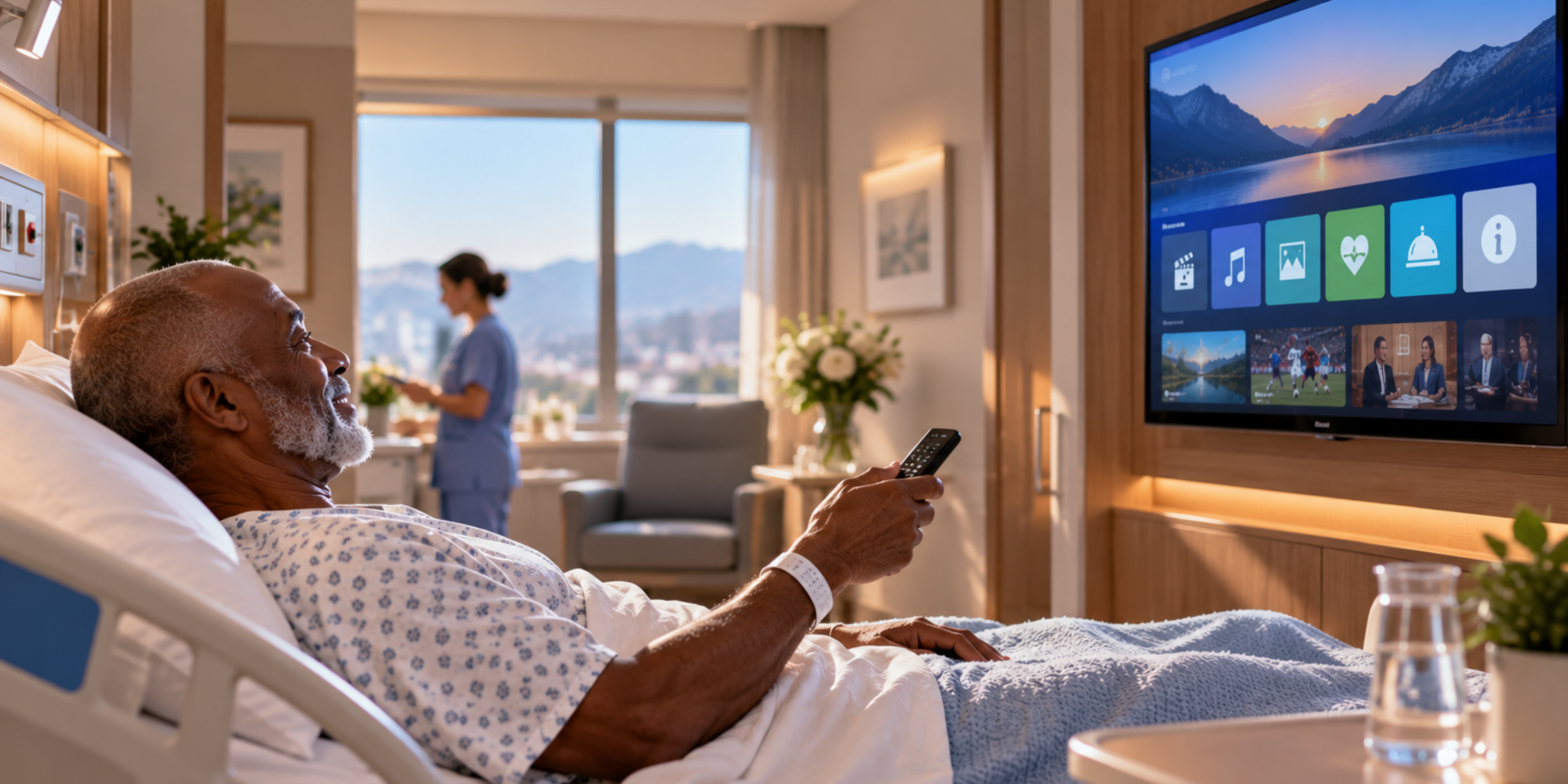
A hospital room is no longer just a place where patients receive care. It is an environment where they rest, communicate, access information and spend long periods of time away from the familiar comforts of home.
Yet, in many facilities, the television at the bedside has remained largely unchanged. Traditional hospital TVs can be difficult to navigate, disconnected from the wider patient experience and limited in what they can offer beyond basic entertainment. At the same time, patients arrive with very different expectations. They are used to intuitive smart TVs, streaming services, connected devices and technology that puts control at their fingertips.
This creates an important challenge for healthcare providers: how do you deliver the familiar, intuitive digital experiences patients expect without compromising the security, reliability and control required in a clinical environment?
Interactive TV in healthcare offers a way to bridge that gap. By transforming the bedside screen into a connected, patient-facing platform, hospitals can create a more comfortable and engaging experience while supporting communication, information access and operational efficiency.
The opportunity is not simply to give patients a better television. It is to rethink what the screen in a hospital room can do and how technology can contribute to a more connected, dignified and patient-centred care environment.
The Evolution of the Modern Hospital Room
The hospital room is becoming an increasingly connected part of the patient journey. As healthcare providers look for ways to improve patient experience while making better use of technology and resources, the bedside screen presents an opportunity that goes far beyond traditional entertainment.
From Traditional Hospital TVs to Interactive Patient Experiences
For years, the hospital television has served a relatively simple purpose: provide patients with something to watch during their stay. But as digital experiences and patient expectations have evolved, that model is increasingly out of step with what people experience in their everyday lives.
Patients are accustomed to choosing what they watch, accessing information on demand and controlling connected devices from their smartphones. An interactive hospital TV can bring some of that familiarity into the patient room, turning the bedside screen into a useful point of interaction rather than simply another appliance on the wall.
With the right platform, the screen can support more than entertainment. It can provide access to relevant information, patient education, communication and selected services, helping patients feel more informed and more in control of their environment.
The shift is therefore not simply from an old television to a newer television. It is a shift from passive viewing to an interactive patient experience.
Bridging Consumer Expectations with Clinical Security
The challenge is that healthcare cannot simply replicate the technology experience people have at home.
Consumer technology is designed primarily for convenience and personal use. A hospital environment has additional requirements around privacy, security, reliability and control. Devices need to operate within a carefully managed environment, while patient information and access to services must be protected.
This is where the distinction between a familiar user experience and the technology behind it becomes important. Patients should not need to understand the complexity of the system supporting their experience. They should be presented with an interface that feels intuitive and familiar, while healthcare providers retain the level of control required within a clinical environment.
For us, this balance is central to the way we approach interactive TV in healthcare: make the experience simple for the patient while keeping the technology secure, controlled and manageable for the organisation.
Overcoming Legacy Infrastructure and Interoperability Challenges
Modernising the patient room is not always as simple as installing a new screen. Healthcare facilities often have existing infrastructure, network environments and technology platforms that need to work alongside any new solution.
This can make large-scale upgrades more complex, particularly when technology needs to be deployed across multiple patient rooms and integrated into an existing operational environment.
A successful interactive TV solution therefore needs to consider the wider technology ecosystem, not just the screen itself. It needs to be practical to deploy, manageable across multiple rooms and capable of fitting into the infrastructure and workflows already in place.
The goal is not technology for its own sake. It is to create a connected patient-room experience that adds value without introducing unnecessary complexity for the teams responsible for managing it.
Why Interactive TV Matters in Healthcare
Interactive TV has the potential to become much more than an entertainment platform. When it is thoughtfully designed and integrated into the patient environment, the bedside screen can become another touchpoint between the patient, their care team and the hospital.
For us, the value lies in creating an experience that serves both sides of the hospital environment: giving patients greater choice, comfort and access to information, while helping healthcare teams deliver a more connected and efficient experience.
Elevating the Patient Experience
- The consumerisation of healthcare: Today’s patients are accustomed to seamless digital experiences at home. They use smartphones, smart TVs and connected devices every day, and increasingly expect the same level of convenience when they enter a healthcare environment. Replacing the traditional hospital TV with an interactive experience can help bridge that gap. Instead of simply providing something to watch, the bedside screen can give patients access to entertainment, information and selected services in a way that feels familiar and intuitive.
- Putting patients in control: Depending on the configuration of the platform, patients can access digital menus, view relevant information, access educational content and interact with selected services directly from their room. When patients have easier access to information and greater control over aspects of their environment, technology can help create a more comfortable and engaging hospital experience.
- Supporting comfort and reducing anxiety: Hospital stays can be stressful, particularly when patients are uncertain about what is happening around them. Accessible entertainment, clear information and patient education can provide valuable distraction while helping patients feel more informed about their care journey. The goal is not simply to give patients more content. It is to use technology thoughtfully to create an environment that feels more familiar, accessible and supportive.
Supporting Clinical Workflows and Reducing Non-Clinical Interruptions
- Reducing non-clinical interruptions: Healthcare professionals operate in demanding environments where their time and attention are valuable. Routine requests and information queries can create additional interruptions for clinical teams, even when they do not require direct clinical intervention. Interactive technology can help move some of these interactions into a self-service environment. Depending on how the solution is configured, patients can access information, services and certain controls directly through the patient-facing platform.
- The power of automation: By making relevant information and services accessible through the bedside screen, some routine interactions can be handled without requiring staff intervention every time. This does not replace human interaction — and it shouldn’t. Instead, it helps remove avoidable friction so that healthcare professionals can focus their attention where it matters most.
- Supporting staff efficiency: Every routine interaction that can be handled through an intuitive self-service experience has the potential to give staff more time for direct patient care and other important responsibilities. For us, the value of automation is therefore not about reducing human interaction. It is about making better use of the time healthcare professionals already have.
Enterprise Reliability, Security and Centralised Management
- The hidden cost of consumer technology: While standard consumer equipment may appear to offer a straightforward route to upgrading patient rooms, healthcare environments have requirements that go well beyond those of a typical home. Technology needs to be reliable, centrally managed and appropriately controlled, particularly when it is deployed across multiple rooms and used by different patients throughout the day.
- Operator-grade control and centralised management: An operator-grade platform gives hospital IT and operational teams greater visibility and control over patient-facing endpoints. Depending on the deployment, this can allow teams to manage screens centrally, update content and software, monitor the environment and troubleshoot issues remotely rather than relying on physical intervention for every room. This becomes increasingly important as a solution scales across a facility. What may be manageable across a handful of rooms can become a significant operational challenge when hundreds or thousands of endpoints are involved.
- Data security and patient privacy: Security also needs to be considered throughout the patient journey. Any platform operating within a healthcare environment must be designed with appropriate controls around access, patient information and the transition between users. A secure, centrally managed environment helps healthcare organisations maintain greater control over the patient-facing experience and reduce the risks associated with unmanaged consumer technology.
Creating Operational and Financial Value
- Reducing IT overhead: Centralised management can reduce the amount of manual intervention required to maintain multiple patient-room endpoints. Remote monitoring and troubleshooting can help teams identify and address issues without always requiring a technician to physically enter the room. Over time, this can make the technology environment easier to manage as the number of connected patient rooms grows.
- Making better use of existing infrastructure: Interactive TVs can also serve multiple purposes within the hospital environment. Depending on the platform and configuration, the same screens can support patient information, internal communications, wayfinding and other digital content alongside entertainment. This allows the bedside screen to become part of the wider digital infrastructure rather than remaining an isolated piece of equipment.
- Creating opportunities beyond entertainment: When thoughtfully implemented, interactive TV can support both patient experience and operational objectives. It can help hospitals communicate more effectively, provide relevant information digitally and create a more connected environment for patients and staff. The value therefore extends beyond the television itself. It is about making the patient-room technology investment work harder for the organisation while creating a better experience for the people using it.
How Our Interactive TV Solution Works
For healthcare organisations, modernising the patient room should not mean replacing familiar technology with complicated, proprietary hardware. Our approach is built around creating a patient experience that feels simple and intuitive, while giving hospital teams the control and manageability they need behind the scenes.
Familiar Consumer-Grade Hardware with Enterprise Control
One of the barriers to modernising patient rooms can be the cost and complexity associated with specialised healthcare hardware.
We take a different approach. We use high-reliability consumer-grade TVs and combine them with specialised, operator-grade software that provides the control, security and management capabilities required in a healthcare environment.
This allows hospitals to benefit from familiar, high-quality screens without requiring patients to learn an entirely new type of technology. At the same time, the underlying platform gives the organisation greater control over the patient-facing experience.
It is a practical balance between consumer familiarity and enterprise control.
Simple, Familiar Access with QR Codes
The technology should be easy for patients to use from the moment they enter the room.
Rather than relying solely on a complicated, multi-button remote or requiring patients to navigate an unfamiliar interface, our platform can use QR-code access to make connecting with the patient experience simple.
Patients can scan the QR code on the screen using their own smartphone, providing a familiar way to access supported services and entertainment.
This approach also removes some of the friction associated with shared physical remotes, while giving patients a device they already know how to use.
Putting Patients in Control
An interactive patient-facing TV can turn the bedside screen into a useful point of interaction throughout the hospital stay.
Depending on the configuration and services available, patients can use the platform to access digital menus, information, entertainment and other patient-facing services. This creates a more engaging experience and gives patients greater independence in managing aspects of their stay.
The screen can also support communication between patients and the hospital, helping deliver relevant information and updates in a way that is accessible from the room.
For us, the principle is simple: technology should give patients more choice and control, without making the experience more complicated.
Secure Patient Turnaround and Data Privacy
Patient turnover creates another important consideration. When one patient leaves and another arrives, any technology used in the room needs to be ready for the next person while protecting the privacy of the previous patient.
Our platform is designed to support this process by allowing the patient-facing environment to be wiped clean with a single click, with the option for this process to be triggered automatically through the hospital’s management environment where supported.
This creates a more streamlined handover between patients and helps ensure that the digital experience in the room starts afresh for every new admission.
In a healthcare environment, privacy cannot be an afterthought. It needs to be considered as part of the entire patient-room technology experience — from how patients access the system to how their session is securely cleared when their stay comes to an end.
Why Our Approach Matters
Modernising the hospital room is not simply a matter of adding more technology. The solution needs to work for the people using it, the teams managing it and the organisation investing in it.
Our approach is designed around that balance. By combining familiar consumer-grade screens with operator-grade control, we give hospitals a way to introduce a more connected patient experience without unnecessarily increasing the complexity of the technology environment.
It also means the solution can be approached as a practical, scalable platform rather than a once-off hardware installation. Patient rooms can be brought into a more modern digital environment while the technology remains centrally manageable and adaptable to the needs of the facility.
For patients, that means a more familiar and intuitive experience. For hospital teams, it means greater control and easier management. And for the organisation, it means an opportunity to modernise the patient room using technology that is designed around both experience and operational practicality.
We believe the best healthcare technology is technology that works quietly in the background, while making the experience in the foreground feel simpler, more connected and more human.
Flexible, Fully Supported Healthcare Technology
Introducing new technology into a hospital environment needs to be practical from both an operational and financial perspective. A solution may deliver an excellent patient experience, but it also needs to be manageable over time and supported by a partner who understands the demands of a 24/7 healthcare environment.
That is why we have built flexibility and ongoing support into our approach.
A Flexible Month-to-Month Software Model
Healthcare facilities need the ability to adapt as their requirements, capacity and budgets change. A rigid technology commitment can make it difficult to scale a solution across additional rooms or adjust the service as operational needs evolve.
Our software model operates on a month-to-month basis, giving hospitals greater flexibility without requiring a long-term software commitment. This makes it easier to scale the solution as needed and align the technology investment with the facility’s current requirements.
It also allows organisations to introduce the platform progressively, rather than having to make a significant upfront commitment across the entire facility.
Remote Monitoring and Onsite Support
In a 24/7 healthcare environment, technology needs to be supported beyond the initial installation.
Our service agreement combines remote monitoring and support with onsite assistance, giving hospital teams access to help when they need it. Remote support allows potential issues to be identified and addressed without always requiring a technician to visit the patient room, while onsite support is available when physical intervention is required.
This combination gives healthcare teams a dedicated technology partner rather than simply a product supplier.
Our goal is to keep the technology working reliably in the background, so hospital teams can focus on what matters most: delivering care and creating a positive experience for their patients.
Transform the Patient Room into a More Connected Care Environment
A hospital stay can be stressful, uncertain and exhausting. The technology surrounding a patient should not add to that experience. Instead, it should help create an environment where patients feel more informed, comfortable and connected.
Interactive TV gives hospitals an opportunity to rethink the role of the bedside screen. What was once simply a source of entertainment can become a more useful part of the patient journey — providing access to information, entertainment and services while supporting communication and giving patients greater control over their experience.
For healthcare organisations, the opportunity goes beyond upgrading the television. It is about creating a more connected care environment that brings together patient experience, technology and operational efficiency in a practical way.
We believe technology should feel effortless to the people using it and remain manageable for the people responsible for it. By combining familiar screens with secure, operator-grade control, flexible software and ongoing support, we help healthcare facilities take a practical step towards the connected hospital room.
Bring Comfort and Dignity Back to Your Facility
Every patient deserves to feel comfortable, informed and connected during their time in hospital.
If you are looking to modernise your patient rooms with a flexible, fully supported interactive TV solution, talk to our team about how we can help you create a more intuitive and connected patient-centred experience.